
Referral works best when it feels like a continuation of a good customer moment, not a recurring request from the marketing calendar.
Start with clean data and a real test plan
The integration starts in Talkable’s App Store. Once connected, a brand can enable the actions it wants sent to Klaviyo. That includes email and phone opt-ins, offer shares, referral approvals, reward issuance, loyalty actions, and loyalty tier transitions.
Do not just flip every switch and call it done. Use Talkable’s Send sample payload tool for every enabled action. Confirm that the event arrives in Klaviyo, that it belongs to the correct person, and that the properties your team plans to use actually resolve in the event preview. This catches missing permissions, mismatched field names, and empty Liquid values before they make their way into a customer email.
Klaviyo integration readiness
Build the first flow from data you have actually tested.
- 01 Authorize the current connection
Reinstall or reauthorize older connections if the starter segments are missing in Klaviyo. - 02 Choose the events with a job to do
Turn on only the opt-ins, shares, approvals, rewards, or loyalty actions that support a flow or report. - 03 Send a sample payload
Check the person, event properties, and Liquid values before a real customer ever sees the message. - 04 Write down the field rules
Keep durable referral facts on the profile and one-time details on the event that triggered the flow.
Brands that connected Klaviyo before Talkable added segments may need a reinstall. The newer segment feature uses Klaviyo’s segment permissions, and an older authorization can leave Talkable unable to create them.
Know what belongs on the profile and what belongs on the event
Talkable updates Klaviyo profiles with durable referral context. That includes whether the person is an advocate, their total, pending, and approved referral counts, their share count, the date of their latest offer, the campaign name and tags, and referral source information for friends.
For a referred customer, Talkable can store talkable_referred_by_email, talkable_referred_by_first_name, and talkable_referred_by_last_name. That opens the door to a welcome flow that recognizes the customer came through a recommendation rather than treating them like every other new subscriber.
Profile properties
Use these for facts that should persist: advocate status, referral history, who referred the customer, and campaign context.
Examples: talkable_advocate, talkable_referral_count_approved, talkable_latest_offer_date
Event properties
Use these for the details of a particular moment. They are available in the flow triggered by that metric.
Examples: reward_code, reward_amount, share_channel, offer_name
That distinction matters. A reward code is useful in the reward email, but it should not become a permanent profile field that gets reused by mistake six months later. On the other hand, an advocate’s approved-referral count is exactly the kind of information a future audience should be able to use.
Use simple snake_case names for custom event properties. Avoid the talkable_ prefix because Talkable manages it and can overwrite it. Also remember that event properties are only available in metric-triggered flows. For campaigns and flows triggered by a segment or profile change, use the profile-property layer instead.
Build flows around real referral moments
Talkable sends five core metrics into Klaviyo: Email Opted In, Phone Opted In, Offer Shared, Referral Approved, and Reward Issued. Each one can be a much better starting point than a broad referral blast.
1. New advocate, no share
Talkable creates a starter segment called Talkable Opted In Never Shared. It captures advocates who opted into marketing but have not shared their offer. This is often the best first flow to launch because it addresses the most obvious drop-off point.
Keep the first email short. Bring the advocate back to their personal offer. Make the friend benefit clear. Give them a frictionless way to share by email, text, or link. If there is a genuine reason to act now, such as a seasonal offer or new collection, use it. A generic reminder is usually not enough.
2. Offer shared
An offer share is a high-intent action. Trigger a simple confirmation from Talkable Offer Shared that reassures the advocate the share went through, explains what happens if their friend buys, and gives them a way back to their offer.
Do not turn this into a long nurture series. The customer has already done what you asked. The useful follow-up is one that recognizes the action and keeps the next step clear.
3. Referred customer welcome
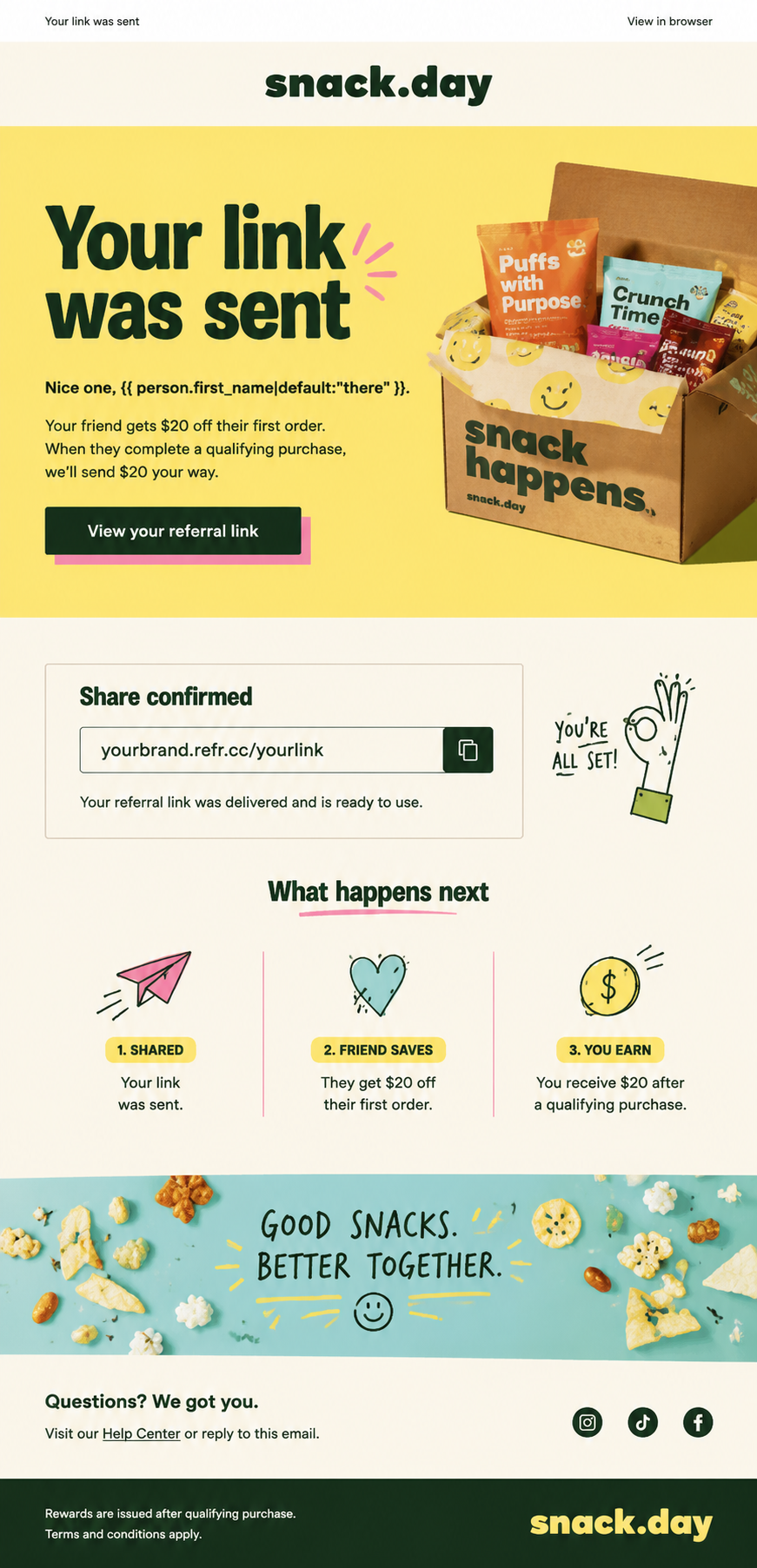
Use the Talkable Referred Customers segment to give referred customers their own welcome path. If it fits the brand voice, acknowledge the advocate by first name. Then make the friend offer, first purchase path, and brand introduction feel connected.
A friend who comes through a recommendation has already crossed a trust threshold. The welcome series should build on that rather than dropping them into a generic acquisition flow with no clue how they arrived.
The referral message does not need to dominate the welcome series. It just needs to tell the truth about why this customer is here.
talkable_referred_by_first_name when it is available. It makes the referral feel like a recommendation rather than a generic acquisition email.4. Referral approved
When Talkable fires Talkable Referral Approved, the advocate has done the hardest part: they brought in a qualified new customer. This is the moment to confirm the success, explain the reward status, and make another share feel earned rather than needy.
Brands can personalize this email with profile properties such as talkable_referral_count_approved. For example, a customer who just reached their third approved referral might receive a different thank-you than someone who just earned their first.
5. Reward issued
Reward confusion kills referral momentum. Use Talkable Reward Issued for a dedicated transactional-style flow. State the benefit, how to redeem it, when it expires, and where to find the code. Do not make people log in and hunt for something they earned.
Referral journey wiring
Give each customer moment one clear next message.
- 01
Advocate receives an offerProfile context: campaign and latest offer date
Segment into the no-share flow
- 02
Advocate sharesEvent: Talkable Offer Shared
Confirm the share. Explain what happens next.
- 03
Friend convertsProfile context: referred-by details
Send a welcome that recognizes the recommendation.
- 04
Referral is approvedEvent: Talkable Referral Approved
Celebrate the qualified referral.
- 05
Reward is issuedEvent: Talkable Reward Issued
Make redemption obvious and easy.
Give strong advocates a different experience
Talkable also creates Talkable High-Value Advocates, which includes people with at least three approved referrals. These customers are already showing that they can introduce the brand to people who buy. A generic discount email is not much of a thank-you.
For some brands, this group is a natural audience for early access. Others may offer a stronger referral benefit, a private product drop, a personal note from the team, or an ambassador conversation. The offer depends on margin and category. The point is to recognize behavior that is already valuable.
The Talkable Lapsed Advocates segment identifies advocates who have shared before but have not received a referral offer in at least 30 days. Re-engage them with something timely: a gifting season, a restock, a product launch, or a new friend incentive. “We miss you” is not a reason to recommend a brand to a friend.
Put referral prompts where customer momentum already exists
The best referral invitation does not feel like an interruption. For many ecommerce brands, that means asking after the customer has had time to experience the product. Delivery, replenishment, a positive review, a milestone, and a second purchase all tend to be better moments than an immediate post-checkout ask.
There are obvious moments to suppress as well. Do not send a referral request to someone with an open support issue, recent return, failed payment, cancellation, or fraud review. Referral is a trust ask. If the customer is frustrated, the message can do more harm than good.
Use talkable_shares_count and talkable_latest_offer_date to avoid sending the same person repeated asks. Customers who shared yesterday should not be pulled into a broad referral reminder today.
Measure approved referrals, not just activity
A share is a useful signal. It is not the finish line. Reporting should follow the full path: offers received, shares, referred-customer conversion, approved referrals, rewards issued, reward redemption, and the performance of each Talkable campaign.
Add a few meaningful event attributes to support that analysis. share_channel can show whether copied links, email shares, SMS, or social shares produce the most approved referrals. campaign_name and campaign tags can separate a holiday offer from an always-on program. Klaviyo’s metric reporting can then filter and group referral events by those properties.
The reporting question that matters
Which referral actions bring in qualified customers?
Shares are useful. Approved referrals, repeat purchase, and reward redemption tell you whether the program is bringing in customers worth having.
Implementation note: Use profile properties such as talkable_referral_count_approved in segment or profile-triggered flows. Use event fields such as {{ event.reward_code }} only in the metric-triggered flow where that event exists.
A sensible launch order
- Validate the integration. Test permissions, payloads, events, and profiles before launch.
- Launch the core flows. Start with no-share advocates, referred customers, approved referrals, and reward issuance.
- Add advocate programs. Bring in high-value and lapsed-advocate audiences after the basics are producing clean data.
- Review performance weekly. Watch opt-ins, shares, approvals, rewards, unsubscribes, conversion, and campaign-level results.
Talkable supplies the referral events and customer context. Klaviyo gives the team a place to act on them. When both are set up with care, the inbox stops being a disconnected marketing channel and becomes part of the referral experience customers are already having.
Frequently asked questions
What Talkable events can trigger Klaviyo flows?
Talkable can send Email Opted In, Phone Opted In, Offer Shared, Referral Approved, Reward Issued, loyalty action, and loyalty tier-transition events to Klaviyo when the matching action is enabled.
Can I personalize a Klaviyo email with referral details?
Yes. In a metric-triggered flow, custom event properties are available as {{ event.property_name }}. Talkable profile properties can also be used for durable facts such as referral count and advocate status.
Why is my Talkable segment missing in Klaviyo?
Older installations may lack the Klaviyo segment permissions Talkable needs. Reinstalling the Talkable app can grant the current scopes and create the starter segments.
Should brands send referral emails to every customer?
No. Target people at positive moments in their lifecycle and suppress customers who have unresolved service, return, payment, cancellation, or fraud issues.
What should a reward-issued email include?
State the reward, redemption instructions, expiration date if one exists, and a direct route to use it. The customer should not have to search for what they earned.
Can I rename the Talkable-created Klaviyo segments?
It is better to edit their conditions in place. If a Talkable segment is renamed or deleted, Talkable may recreate the original name when the app is activated again.
Build the program around the customer journey
Ready to make referral part of your lifecycle?
Talkable gives ecommerce teams the tools to test, measure, and grow customer advocacy.