
You’ve heard the term thrown around in tech circles. Investors love it. Founders obsess over it. But what actually are network effects, and why should you care?
Here’s the simple version: A network effect happens when your product gets more valuable every time someone new starts using it.
That’s it. That’s the whole concept.
But the implications? They explain why Facebook crushed MySpace, why Uber dominates ride-sharing, and why your group chat is probably still on WhatsApp even though you hate it.
The Party Analogy
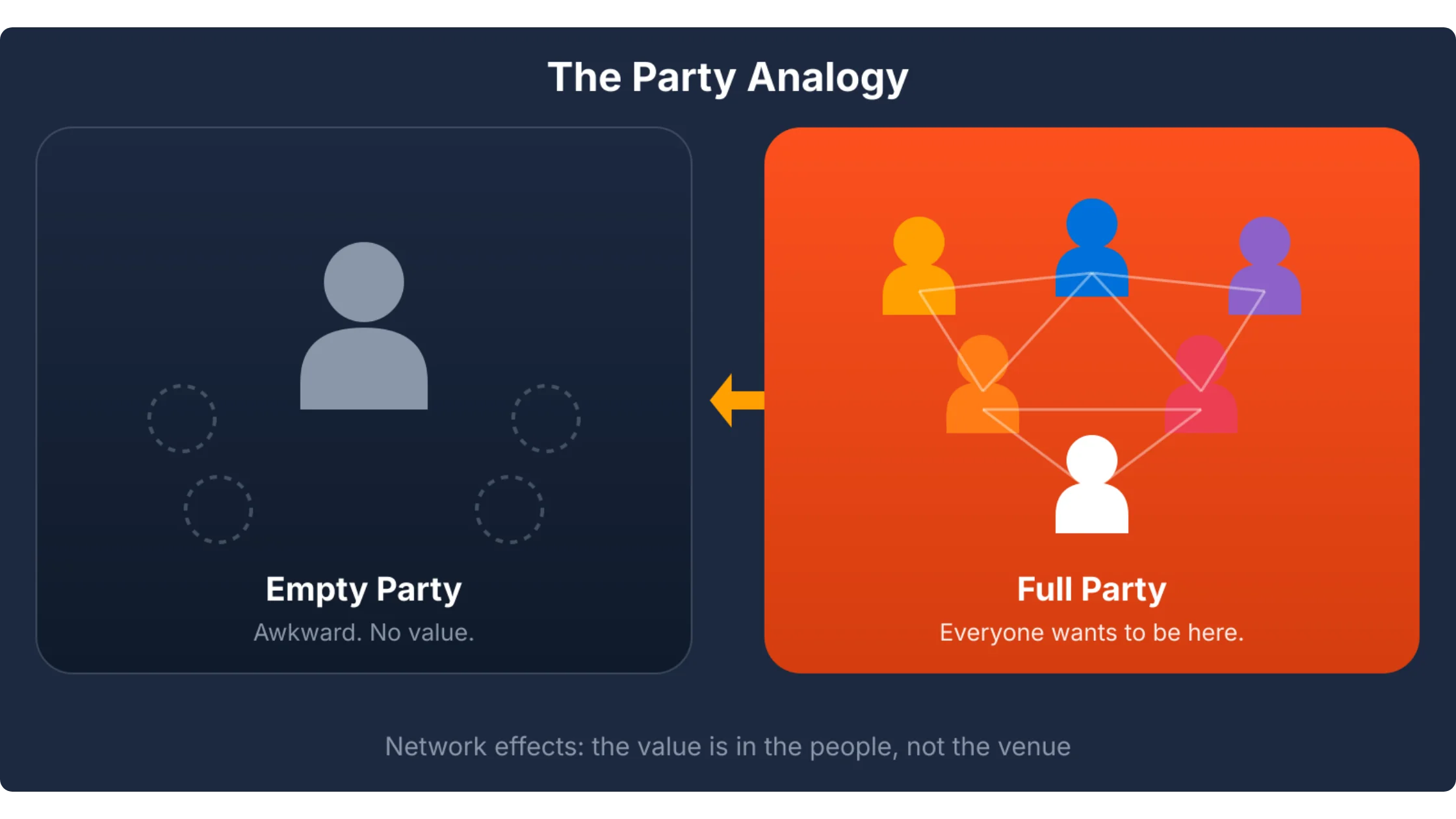
Think of network effects like a party.
An empty party is awkward. Nobody wants to be there. But as more people show up, the party gets better. More conversations. More energy. More reasons to stay.
At some point, the party hits critical mass. Now it’s the place to be. People hear about it and show up specifically because everyone else is already there.
That’s a network effect in action.
Now imagine you’re throwing a competing party across the street. You could have better music, better drinks, a nicer venue. But if the other party already has all the people? Good luck getting anyone to leave.
This is why network effects are considered the strongest competitive moat in business. Once you have them, you’re incredibly hard to beat.
The Three Laws You Need to Know
Nerds have created mathematical laws to explain how networks grow in value. Here’s the simplified version:
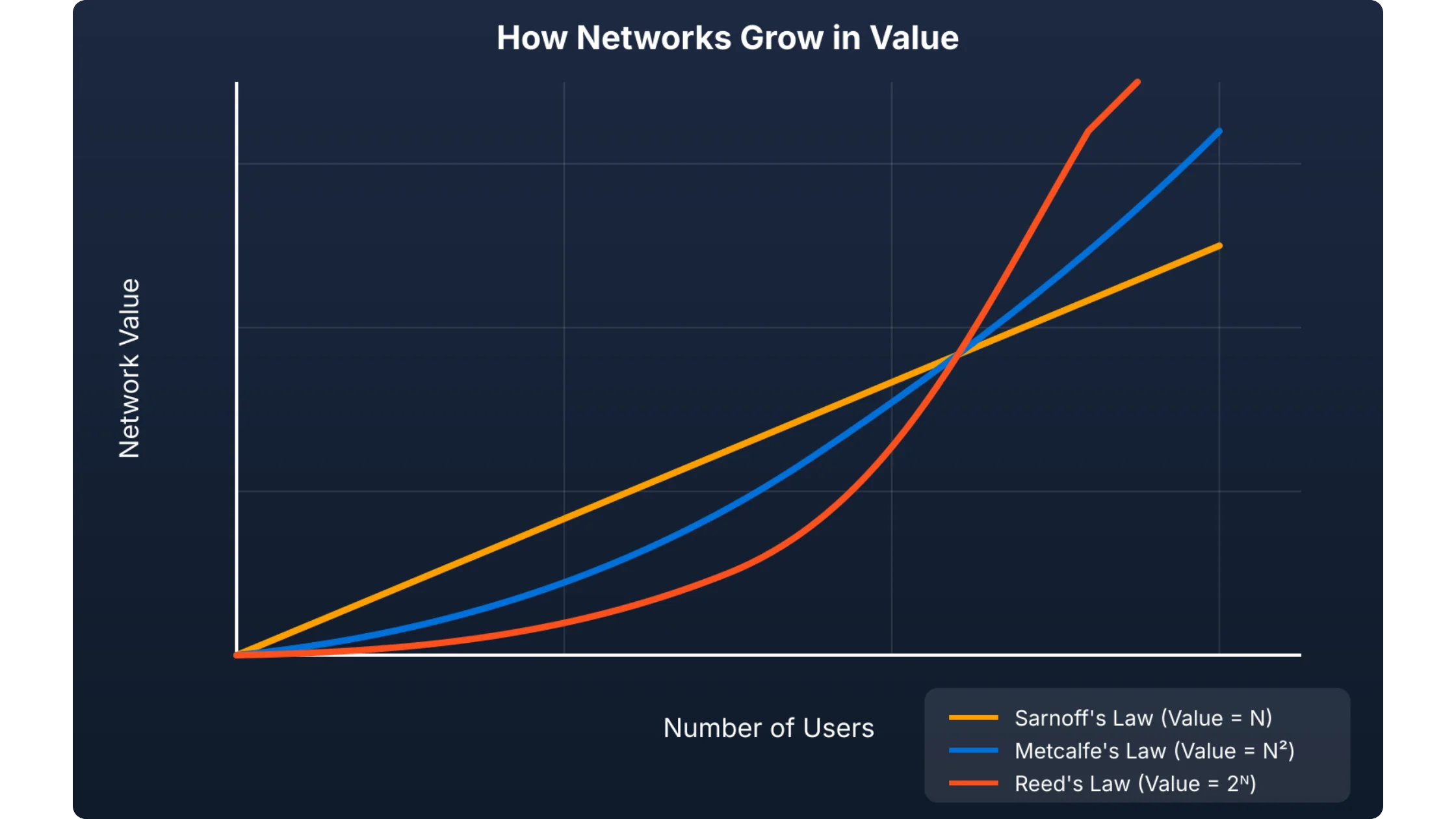
Sarnoff’s Law (Linear Growth) Value = Number of Users
Think: A TV broadcast. More viewers = more ad revenue. Simple math.
Metcalfe’s Law (Exponential Growth)
Value = Number of Users²
Think: A phone network. With 2 people, you have 1 possible connection. With 5 people, you have 10. With 100 people, you have nearly 5,000. The value explodes.
Reed’s Law (Hypergrowth) Value = 2^(Number of Users)
Think: Group chats and communities. It’s not just about one-to-one connections anymore. It’s about all the possible groups that can form. Your family chat. Your work Slack. Your fantasy football league. Each subgroup adds massive value.
The takeaway: Not all networks are created equal. The ones that enable group formation (like Slack, Discord, or Facebook Groups) can grow in value faster than ones that only enable one-to-one connections.
The Five Types That Actually Matter
The original source lists 13 types of network effects. That’s too many. Here are the five you’ll actually encounter:
1. Direct Network Effects
What it is: More users = more value for everyone, directly.
Example: Phone networks, messaging apps, social platforms.
Why it matters: These are the strongest. If all your friends are on iMessage, you’re not switching to Signal.
2. Marketplace Network Effects
What it is: More buyers attract more sellers. More sellers attract more buyers.
Example: eBay, Airbnb, Uber, Etsy.
Why it matters: You have to build both sides. It’s the classic chicken-and-egg problem.

3. Platform Network Effects
What it is: More users attract more developers. More apps attract more users.
Example: iOS, Android, Windows, Salesforce.
Why it matters: Once developers build for your platform, users are locked in. And once users are locked in, developers keep building.
4. Data Network Effects
What it is: More users = more data = better product for everyone.
Example: Waze (more drivers = better traffic data), Google (more searches = better results), Spotify (more listeners = better recommendations).
Why it matters: Your product literally improves as it scales. That’s a compounding advantage.
5. Belief Network Effects
What it is: Value comes from collective belief, not utility.
Example: Bitcoin, brand loyalty, community identity.
Why it matters: These are fragile but powerful. If belief wavers, the network can collapse fast.

The Dark Side: When Network Effects Work Against You
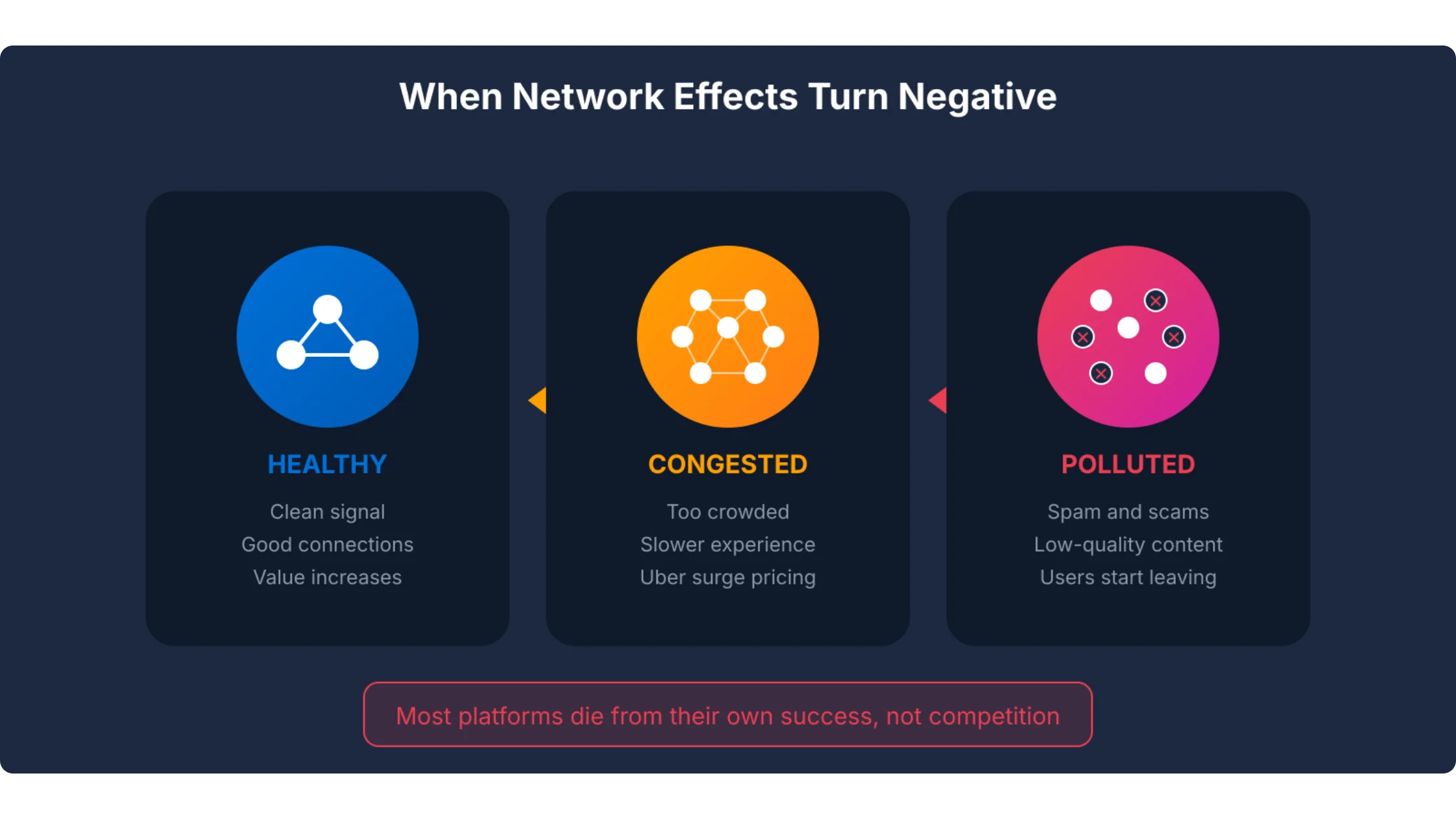
Here’s what most articles won’t tell you: network effects can also be negative.
Network Congestion Too many users can degrade the experience. Think of Uber during surge pricing, or Twitter during a major event when the servers slow down.
Network Pollution
More users can mean more spam, scams, and garbage content. This is why every social platform eventually feels worse than when it started.
Asymptotic Limits At some point, adding users stops helping. Uber doesn’t get much better once wait times hit 4 minutes. Adding more drivers after that point doesn’t improve your experience.
How to Actually Build Network Effects
Okay, so network effects are powerful. How do you create them?
Step 1: Solve the Cold Start Problem
Your network is worthless with zero users. You need to create value before the network effects kick in.
Strategies that work:
- Single-player mode: Make the product useful even with one user (Instagram filters worked before anyone followed you)
- Fake it: Seed the marketplace yourself (Reddit founders created fake accounts to populate early discussions)
- Go narrow: Dominate one small network before expanding (Facebook started at Harvard only)
Step 2: Find Your “White-Hot Center”
Not all parts of your network are equal. Find the cluster with the highest density and activity. Double down there.
Uber didn’t try to launch everywhere. They found the San Francisco tech crowd who needed rides to bars and airports. That was their white-hot center.
Step 3: Create Switching Costs
Network effects create natural lock-in, but you can reinforce it:
- Social graph: Hard to leave when all your connections are there
- Content/data: Years of photos, posts, or playlists
- Integrations: When your product is wired into their workflow
Step 4: Watch for Negative Effects
As you scale, actively combat congestion and pollution. Content moderation, spam filters, and quality controls aren’t optional. They’re survival.

The Bottom Line
Network effects explain why a handful of tech companies are worth trillions while thousands of startups with “better” products fail.
It’s not always about having the best features. It’s about having the most users who make the product better for other users.
If you’re building a product, ask yourself:
- Does my product get more valuable as more people use it?
- What type of network effect am I building?
- How will I solve the cold start problem?
- What will keep users from leaving once competitors show up?
If you can’t answer these questions, you might have a great product. But you probably don’t have a moat.
Network effects account for roughly 70% of all value created by tech companies since 1994. Understanding them isn’t optional if you’re building in tech. It’s the whole game.
About the Author:
Jeremy Foreshew is a full-stack marketer with deep expertise in customer-led growth. As Head of Marketing at Talkable, he helps DTC and eCommerce brands turn their customers into their most powerful acquisition channel. Jeremy writes about referral strategy, retention, and the future of word-of-mouth marketing. He has been featured in Forbes, TechCrunch, and HuffPost.