

Most referral programs do not fail on launch day.
That is the annoying part.
Launch usually looks fine. The emails go out. The landing page is live. A few advocates share. Everyone nods at the dashboard. Then a month later, the graph starts doing that sad little drift downward and nobody wants to say the obvious thing out loud.
The program is alive, but it is not working hard enough.
I have seen this happen at brands with great products, real loyalty, and plenty of customers who would happily recommend them. The issue is rarely that people hate the brand. The issue is that the referral program gets treated like a campaign instead of a revenue system.
That is fixable.
The pressure is real, too. Shopify reported that average customer acquisition cost rose from $13 in 2013 to $29 in 2022, a 222% jump. Nielsen found that 88% of global respondents trust recommendations from people they know more than any other channel. That is the whole tension: paid acquisition keeps getting more expensive, while customer trust is sitting inside the base you already paid to acquire.
Talkable has helped 1000s of ecommerce brands drive more than $3B in referral revenue, with 11x Average ROI and $110M+ in fraud prevented. The pattern is pretty consistent: the programs that keep growing are managed, tested, segmented, protected, and connected to the moments when customers are most likely to share.
This post is the practical version. Why referral programs stall, what the stall usually means, and how to get the flywheel moving again.
A referral program is not “set it and forget it.” It is “launch it, learn from it, then make it earn its keep.”
Average customer acquisition cost rose from $13 in 2013 to $29 in 2022, according to Shopify Enterprise.
Global respondents trust recommendations from people they know more than any other channel, according to Nielsen.
Wharton referral research found referred customers were about 16% more valuable than comparable non-referred customers.
Fraud prevented through Talkable controls, keeping referral growth cleaner and easier to trust.
The launch bump is not the win
A referral launch is usually the easiest part of the whole thing.
You have a fresh announcement. The offer is new. Your team is paying attention. Your best customers are hearing about the program for the first time.
That creates a bump.
The bump is useful, but it is not proof that the program is healthy. It is proof that novelty works. Health shows up later, when the program keeps producing after the novelty fades.
When a program stalls after launch, the first question is not “why did referrals stop?” It is better to ask, “where did the program stop getting managed?”
Referral needs maintenance because customer behavior changes. Paid CAC changes. Inventory changes. Promo calendars change. Your best advocates are not all motivated by the same offer. Fraud patterns shift too. A static program slowly gets less relevant even if the brand stays strong.
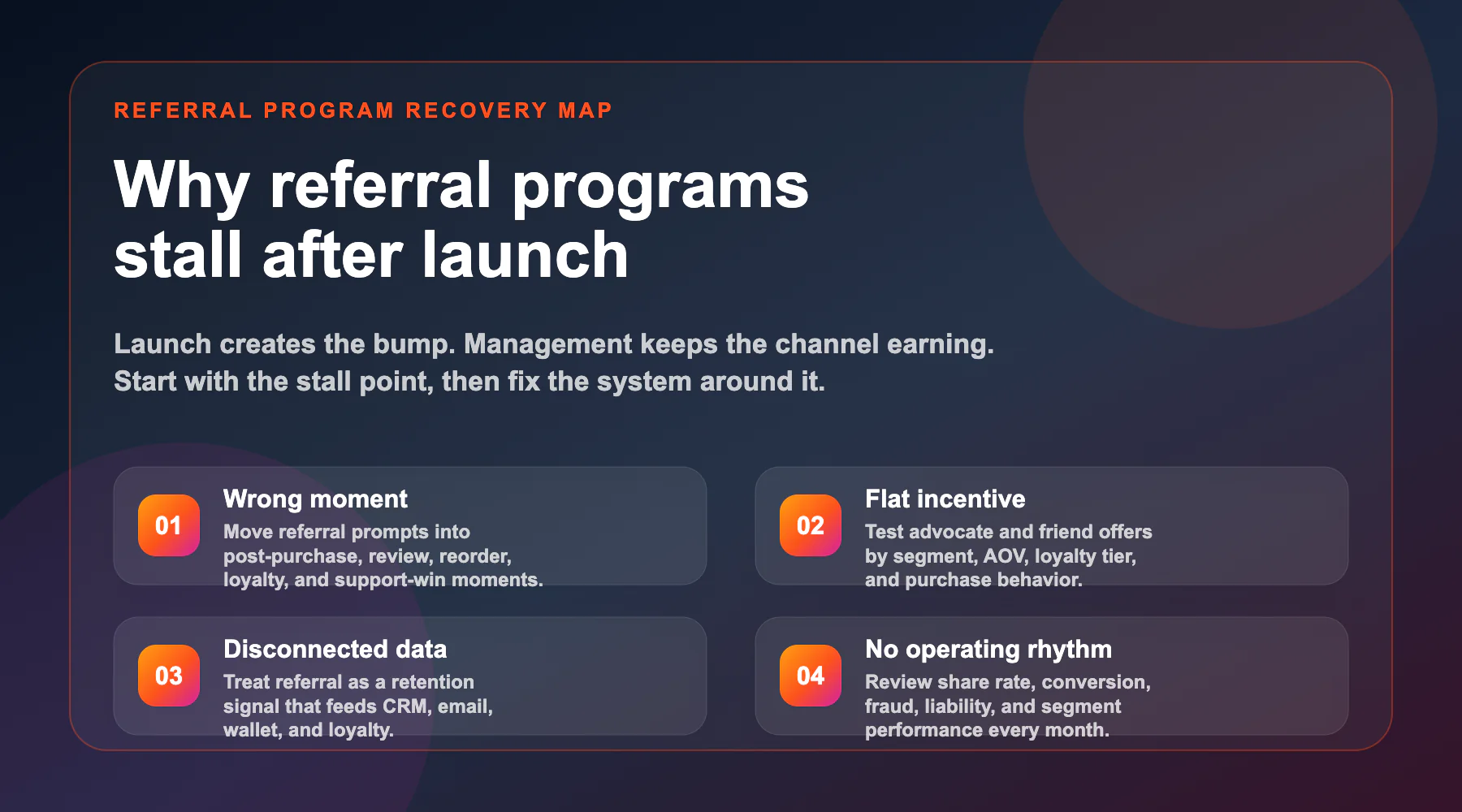
Why programs stall
1. The ask shows up at the wrong moment
A customer is most likely to refer when the brand has just given them something worth talking about. That might be after a great delivery experience, a second purchase, a product milestone, a review, a loyalty action, or a support win.
Too many programs only ask from a footer, account page, or generic email. That is technically available, but emotionally invisible.
The fix is placement. Put referral prompts where customer energy already exists. This is why the post-purchase moment matters. If someone just bought, reviewed, reordered, or hit a loyalty milestone, the brand already has momentum.
2. The incentive does not match the buyer
A flat offer is simple. Simple is not always wrong. But simple can get lazy fast.
A first-time buyer, loyal customer, VIP, subscriber, gift buyer, and high-AOV advocate do not all respond the same way. If every person sees the same offer forever, the program is leaving money on the table.
Better programs test incentive structure by segment. Sometimes cash works. Sometimes credit works. Sometimes the friend offer matters more than the advocate reward. Sometimes the right move is making the reward feel more exclusive instead of more expensive.
This is where incentive management starts to matter. A good customer wallet setup gives brands more flexibility than a static coupon sprayed at everyone.
3. The program is disconnected from retention
Referral is not just an acquisition channel. It is also a loyalty signal.
If someone refers, they are telling you something. They trust the brand enough to put their name on it. That should affect how you talk to them afterward.
The economics back this up. Bain has long argued that small retention gains can have an outsized profit impact. Wharton referral research also found referred customers were about 16% more valuable than comparable non-referred customers.
4. Nobody owns optimization after launch
This is the quiet killer. The program goes live. The team moves on. The dashboard gets checked when someone remembers. Then six months later everyone wants to know why performance is flat.
Referral needs an operating rhythm. Review share rate, friend conversion rate, reward liability, revenue, fraud flags, and segment performance. Then change one meaningful thing at a time.
5. Fraud controls are bolted on too late
Fraud is not just a finance problem. It is a growth problem.
If the program gets abused, teams tighten everything, advocates get annoyed, and the best customers start feeling like they are being punished for the behavior the brand asked them to do.
Fraud prevention has to be part of the program from the start. Talkable has prevented $110M+ in fraud because referral works best when the upside is protected.
The goal is not to make referral harder. The goal is to make clean growth easier to trust.
Stalled program vs managed revenue system
| Program area | Stalled referral program | Managed referral revenue system | Why it matters |
|---|---|---|---|
| Placement | Hidden in footer or account page | Triggered at high-intent customer moments | More customers see the ask when they are ready to share |
| Incentives | Same offer for everyone | Tested by segment and lifecycle stage | Better match between motivation and reward |
| Measurement | Launch report, then dashboard drift | Weekly or monthly optimization rhythm | Problems get fixed before they become normal |
| Retention connection | Referral data sits alone | Referral behavior feeds CRM, email, loyalty, and wallet | Advocates get treated like advocates |
| Fraud | Manual review after abuse appears | Controls built into the program | Growth stays clean without punishing good customers |
What I would fix first
Start with the part of the funnel that is weakest.
If customers are not sharing, fix visibility and advocate motivation. If people share but friends do not buy, fix the friend offer, landing experience, and product fit. If revenue looks good but reward cost looks scary, fix incentive design. If growth is noisy or suspicious, fix fraud controls before scaling.
Low share rate
The ask is hidden, badly timed, or not worth the effort.
Low friend conversion
The friend offer, landing page, or product path is not carrying the trust forward.
High reward cost
The incentive may be too broad, too rich, or poorly segmented.
Fraud noise
Rules, verification, and monitoring need to come before more promotion.
The fix is operational, not cosmetic
Changing button copy might help. A prettier page might help. But most stalled programs need a management layer, not a facelift.
- Segment the audience before changing the offer.
- Map referral prompts to real customer moments.
- Test advocate and friend incentives separately.
- Connect referral behavior to retention channels.
- Review fraud, liability, and revenue together.
- Keep a monthly backlog of tests.
Talkable’s edge is not just launching referral programs. It is helping brands keep them productive after the launch announcement stops doing the heavy lifting. That is the difference between a referral program and a referral marketing platform that actually gets managed.
Referral Recovery Checklist
Find the stall point before you rebuild the whole thing.
- Pull share rate, friend conversion, referred revenue, reward cost, and fraud flags.
- Identify the weakest point in the loop.
- Audit where the referral ask appears today.
- Compare advocate offer and friend offer performance.
- Segment advocates by purchase behavior and loyalty status.
- Choose one test for the next 30 days.
FAQ
Why do referral programs slow down after launch?
Most programs slow down because the launch bump fades and the program is not actively managed. Referral needs placement, testing, segmentation, fraud controls, and a clear owner after launch.
What metric should I check first when referrals stall?
Start with share rate and friend conversion rate. If customers are not sharing, fix advocate visibility and motivation. If friends are not buying, fix the friend experience.
Should I increase the reward when performance drops?
Not automatically. A bigger reward can hide a broken journey. Test the ask placement, audience segment, friend offer, and landing path before assuming the reward is too small.
Is referral mainly an acquisition channel?
No. Referral brings in new customers, but it also identifies advocates. That behavior should feed retention, loyalty, wallet, email, and customer segmentation.
Let’s turn referral back into a revenue channel.
If your program launched well and then went quiet, that does not mean your customers stopped caring. It usually means the system needs better timing, testing, and protection. Talkable can help find the stall point and build the next version around revenue, not guesswork. See more proof in the Talkable case studies, or let’s talk referral revenue.